By the standards of almost any other line item, workforce training enjoys remarkable immunity from scrutiny. American employers spend enormous sums on it every year, renew those budgets annually, and yet only a minority ever establish whether the spending changed anything an executive would recognize as a business result. A procurement process that behaved this way with software or equipment would be a scandal. With training, it is simply the norm.
The scale of the spending is well documented. Training magazine's 2025 Training Industry Report, now in its forty-fourth year, put U.S. training expenditures at $102.8 billion, up 4.9 percent from the year before—the industry's second crossing of the hundred-billion-dollar line this decade. The Association for Talent Development's State of the Industry research tells a similar story of sustained, substantial per-employee investment. The money, in other words, is not the problem. The problem is what the money buys.
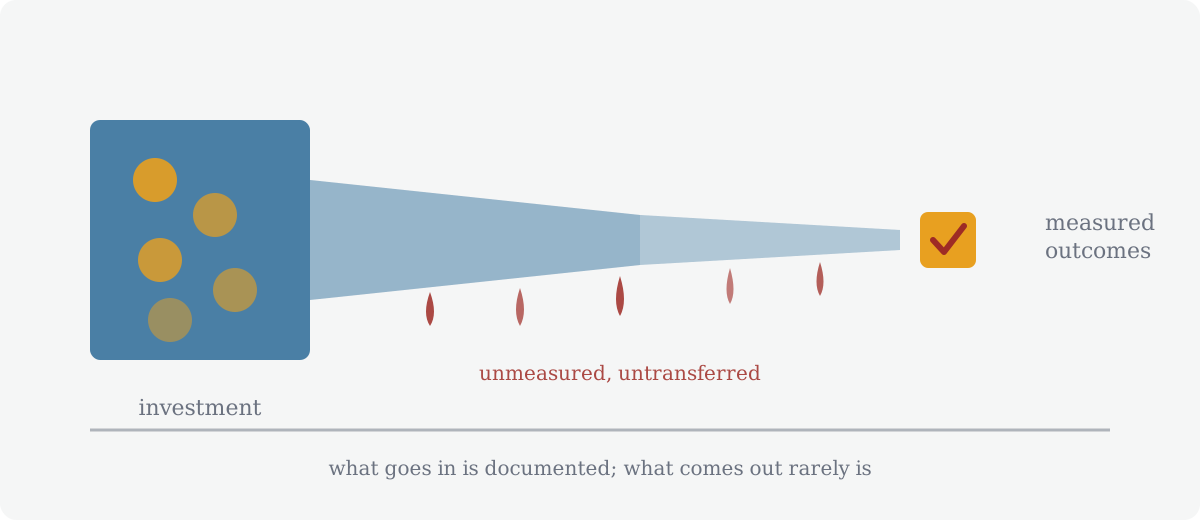
The training pipeline as it too often works: heavy investment in, little measured change out.
What the Money Buys
The most striking evidence of the gap comes from the buyers themselves. In a McKinsey survey of executives, only about a quarter of respondents said their training programs measurably improved business performance—and most companies, McKinsey noted, do not even track the returns on their training investments. The academic literature on transfer of training is more contested but hardly more comforting: estimates of how much training actually transfers into changed on-the-job behavior have ranged from the famously pessimistic ten percent to more generous figures, a debate scholars have examined critically in work such as Fitzpatrick's "10% delusion" analysis. The precise number matters less than the consensus behind the dispute: a large share of what is taught in workplace training never shows up in workplace behavior, and most organizations are not measuring carefully enough to know how large.
None of this means training is worthless—the stakes are moving in exactly the opposite direction. The World Economic Forum's Future of Jobs Report 2025 found that 63 percent of employers already name skills gaps as the biggest barrier to transforming their businesses, and it projects that most of the workforce will need some form of training before 2030. An activity this necessary, funded this generously, and evaluated this poorly is not an argument for spending less. It is an argument for designing better.
A Design Problem Wearing a Measurement Costume
The instinctive diagnosis is that organizations simply need better evaluation—more surveys, more dashboards, more rigor at the end. Frameworks for this have existed for decades; the Kirkpatrick model laid out its four levels—reaction, learning, behavior, results—in the 1950s. Yet in practice most evaluation never gets past the first level, the end-of-course satisfaction survey. The reason is not laziness. It is that most training programs cannot be evaluated at the higher levels, because they were never designed with evaluable outcomes in the first place.
Consider what a typical corporate course actually is: a slide deck inherited from a predecessor, a vendor module bought by seat count, a subject-matter expert's accumulated wisdom arranged in the order it occurred to them. Ask what specific, observable behavior the program is meant to produce, under what conditions, to what standard, and the question often has no answer—not a bad answer, no answer. Without that answer there is nothing for a Level 3 evaluation to look for. The measurement vacuum is downstream of a design vacuum. Training suffers, in concentrated form, the same affliction we have described across the whole short-cycle landscape: content assembled by accretion, standing in for curriculum built by intention.
The structural conditions make the vacuum easy to understand. Training functions are chronically understaffed relative to their mandates, and the people asked to build programs are usually hired for their subject expertise, not for instructional design. When the compliance deadline or the product launch arrives, the course must exist, designed or not. Under those pressures, skipping the analysis phase is not negligence; it is triage. But the cumulative effect of decades of triage is an industry in which the exception is the program that can state what it changed, for whom, and by how much.
What Evidence-Based Design Looks Like
The corrective is not mysterious; it has been the core of instructional design for decades. It begins with backward design, the approach articulated for educators by Wiggins and McTighe in Understanding by Design: identify the desired results first, determine what evidence would show those results have been achieved, and only then plan the instruction. In a training context, that means the design conversation starts with the job task and the performance gap, not with the content inventory. It means every stated outcome is paired, at design time, with an assessment capable of evidencing it—and that the assessment actually measures the outcome it claims to, under conditions that resemble the job, rather than rewarding recall of slides. Validity of this kind is not a statistical nicety; it is the difference between a certificate that predicts performance and one that predicts attendance.
The same discipline extends to structure. Spacing practice over time, interleaving skills, building in retrieval rather than re-exposure, and planning for the post-training environment—manager reinforcement, opportunity to apply—are all design decisions with strong evidentiary support, and all of them are invisible in a program conceived as a one-day content dump. The continuing education world has even codified much of this: the ANSI/IACET Standard for Continuing Education and Training requires documented needs analysis, stated learning outcomes, and assessment aligned to those outcomes as conditions of accreditation. The blueprint for rigor exists. What most training organizations lack is the time, staffing, and tooling to follow it—the median training team is small, its instructional design capacity is thinner still, and the delivery calendar always wins.
Building Quality In from the Start
This is the gap Meliore was built to close. Meliore brings the discipline of backward design to workforce and other short-cycle programs at the speed those programs actually operate. It starts from constraints—the available contact hours, the credential or CEU logic, the audience's starting point—and generates three to five comparable program architectures, each with outcomes, aligned assessments, and structure made explicit, and with the tradeoffs between them laid out for the program owner to judge. Because outcomes and assessments are articulated at design time, the resulting programs are evaluable at design time: the question "did this work?" has something concrete to attach to. Organizations analyzing existing curricula against workforce demands will find complementary ground in Curriculum Assist, and those building full academic programs in Curriculum De Novo.
Workforce training's quality problem is real, but it is neither inevitable nor especially exotic. It is what happens when an educational enterprise grows to a hundred billion dollars without ever adopting the design discipline that education, at its best, already knows. The employers writing those checks are entitled to programs designed on purpose—and the workers sitting through them are entitled to training that was built to change what they can do, not merely to fill the day. Getting there is not a measurement project to be bolted on at the end. It is a design project, and it starts before the first slide is written.