When a university proposes a new bachelor's degree, an elaborate machinery engages. Faculty committees draft learning outcomes and map them to courses. Curriculum councils debate sequencing and prerequisites. Accreditors review assessment plans. State boards weigh in on duplication and demand. The process can be slow to a fault—we have written elsewhere about how that slowness becomes a liability—but no one doubts that the design itself is taken seriously. A degree is understood to be an architecture, and architectures get architects.
Now consider what happens when a county extension office builds a twelve-week producer education series, or a workforce board stands up a six-week certificate in industrial maintenance, or a hospital system assembles a continuing education sequence for nursing staff. In most cases, a subject-matter expert—an agent, a trainer, a clinician—sits down with whatever materials exist and builds the program from experience and instinct. There is no committee, no outcomes map, no assessment review, and usually no instructional designer anywhere in the room. The program may be excellent. But if it is, that is a testament to the individual, not the system. The design rigor that is mandatory for a degree is optional—in practice, absent—for nearly everything else.
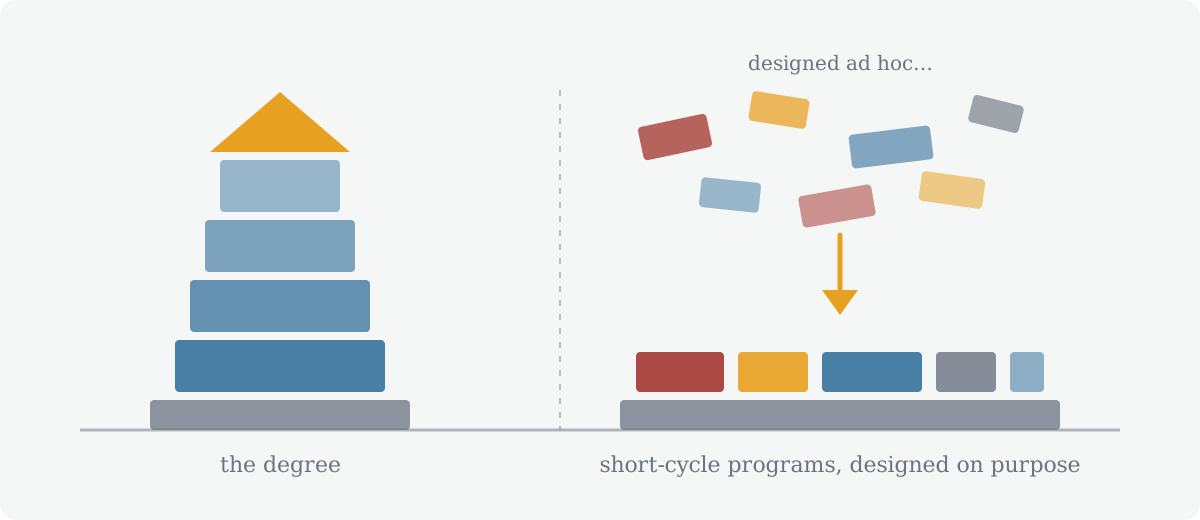
Degrees get architecture. Short-cycle programs get improvisation—and they deserve better.
The Ecosystem Nobody Designed
This asymmetry might once have been defensible on the grounds of scale: degrees were where the learners were. That argument has collapsed. Credential Engine's Counting Credentials 2025 report identifies more than 1.8 million unique credentials offered in the United States across roughly 134,000 providers—and degrees account for only about 264,000 of them. Badges, certificates, micro-credentials, certifications, and licenses make up the overwhelming majority. The Georgetown University Center on Education and the Workforce documented years ago that certificate production had grown by more than 800 percent over three decades, becoming the second most common postsecondary award in the country.
The learners are there too. Lumina Foundation reports that roughly five million students enroll in community college noncredit programs—about two in five of all community college enrollments—most of them in workforce-oriented training. Beyond the campus, the Cooperative Extension System reaches communities in nearly every county in the nation, and 4-H, administered through USDA's National Institute of Food and Agriculture, engages millions of young people annually in structured educational programming. Add employer-funded training, agency and nonprofit programs, apprenticeship-related instruction, and mandatory continuing education across licensed professions, and short-cycle learning is plausibly the largest educational enterprise in the country. It is also the least deliberately designed.
Ad Hoc Is Not a Neutral Default
Does the informality actually matter? The evidence suggests it matters a great deal, because the outcomes of short-cycle programs are strikingly uneven. A 2025 study published in Educational Evaluation and Policy Analysis by Bahr and Columbus found that noncredit occupational training at community colleges is associated with meaningful earnings gains—roughly $2,000 per year on average—alongside higher employment rates. That is genuinely encouraging. But averages conceal variance: Lumina's credentials-of-value tracking finds that only 7.8 percent of working-age adults hold a short-term credential that delivers a labor-market premium, and researchers at Brookings have observed bluntly that noncredit workforce programs are enormously popular and yet "we know next to nothing about them"—there is no common data infrastructure, no shared quality framework, and little visibility into what is actually taught.
When some programs pay off handsomely and many do not, design is one of the few levers a provider actually controls. A program whose outcomes were never articulated cannot be assessed against them. A program assembled by accretion—a module added here, a guest speaker there—cannot be deliberately improved, because no one can say what it was supposed to do. And a program that lives in one educator's head cannot survive that educator's retirement, a problem extension professionals know intimately. None of this is a criticism of the people running these programs. It is a criticism of an ecosystem that gives a faculty committee a year to design a fifteen-week course and gives a workforce trainer a weekend to design a fifteen-week program.
Short-Cycle Design Is Its Own Discipline
Part of the problem is that the field has tried to serve short-cycle programs with tools built for degrees, and the fit is poor. Degree curricula are organized around credit hours, semesters, and course catalogs. Short-cycle programs are organized around different primitives entirely: contact hours, cohort schedules, employer release time, seasonal calendars, licensure clocks. Continuing education has its own formal grammar—under the ANSI/IACET standard, one CEU is defined as ten contact hours of organized instruction under qualified direction, and the standard governs how programs are planned, delivered, and assessed. Youth development programs answer to positive-youth-development frameworks rather than academic outcomes. Extension programming answers to community needs assessments and funder logic models. These are real design constraints, and they deserve to be treated as first-class inputs to program architecture, not as administrative details bolted on after the "content" is chosen.
The demand side, meanwhile, is only growing more insistent. The World Economic Forum's Future of Jobs Report 2025 estimates that 39 percent of workers' core skills will change by 2030, and that if the global workforce were one hundred people, fifty-nine would need training before the end of the decade. Most of that training will not come in degree-sized units. It will come in weeks and weekends, in noncredit certificates and CEU sequences and employer academies—precisely the programs that today receive the least design attention.
What Rigor Would Look Like
Rigor for short-cycle programs does not mean importing the university's committee structure or its timeline. It means importing its discipline while respecting the format's constraints. A rigorously designed short-cycle program starts from explicitly stated outcomes—what a participant will be able to do, observably, at the end. It works backward from those outcomes to assessments that could credibly evidence them, and only then to instructional activities and materials. It models its own logistics honestly: how many contact hours are actually available, what credential or CEU logic applies, what prerequisites the audience realistically brings. It considers alternatives—a competent designer should be able to articulate why a program is structured as three eight-hour Saturdays rather than eight three-hour evenings, and what is gained and lost either way. And it documents all of this, so the program can be evaluated, improved, transferred to a new instructor, and described accurately to the people deciding whether to enroll or to fund it.
None of that is exotic. It is the ordinary practice of curriculum design, applied to programs that have historically been denied it. What has been missing is not knowledge but capacity: the extension educator, the training director, and the program coordinator rarely have an instructional design team on call, and the design work loses out to the delivery work every time the calendar tightens.
Designing Toward Betterment
This is the problem Meliore was built for. Meliore is Perspicax's constraint-first curriculum design platform for programs beyond the traditional degree—workforce and vocational training, cooperative extension, youth development, continuing education, and nonprofit and agency programs. Rather than producing a single take-it-or-leave-it design, it generates three to five comparable program architectures with the tradeoffs made explicit, so the educator—who remains the decision-maker—can weigh a cohort-based intensive against a distributed evening format with eyes open. It models contact hours, CEU logic, and credential requirements natively rather than as afterthoughts, and its outputs are accessible and portable by design. For institutions working within degree structures, Curriculum Assist and Curriculum De Novo continue to serve the analysis and design of academic programs; Meliore extends the same conviction to everything else.
That conviction is worth stating plainly. The learner in a Tuesday-night welding certificate and the teenager in a 4-H project are engaged in education, fully and without qualification, and the programs that serve them deserve the same intellectual seriousness we grant a degree. The name Meliore comes from our shorthand for that commitment—ad meliore, towards betterment. Short-cycle programs are how most Americans will learn for the rest of their lives. It is time we designed them like we mean it.