This is Part 1 of our series, "The Curriculum Refresh Imperative," exploring how data-driven curriculum redesign creates competitive advantage across higher education.
There is a growing body of evidence confirming what many in higher education already sense: the gap between what employers need and what graduates possess is widening, not narrowing. And the traditional mechanisms for closing that gap — periodic curriculum review cycles stretching five to ten years — were strained in the pre-AI era. Today, they are dangerously obsolete.
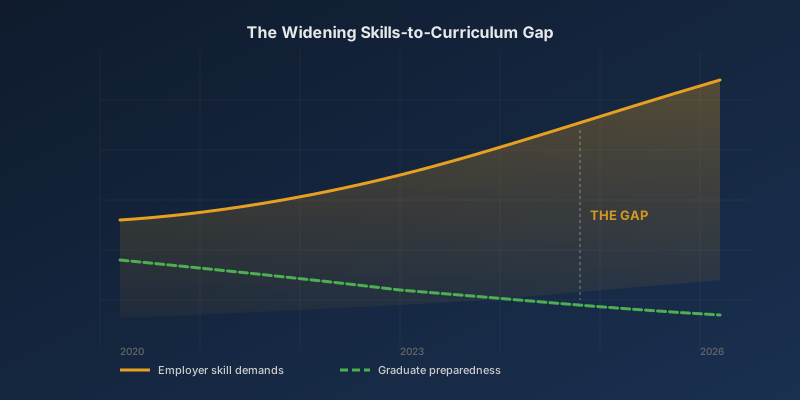
Employer skill demands are accelerating while graduate preparedness struggles to keep pace.
The Numbers Tell the Story
The World Economic Forum's Future of Jobs Report 2025 projects that 39 percent of workers' core skills will change by 2030, and that 59 percent of the global workforce will need training before the decade closes. These are not projections about a distant future — they describe changes already underway.
On the employer side, the picture is equally stark. Eighty-seven percent of executives surveyed in 2025 reported experiencing workforce skill shortages. Georgetown University research indicates that credential providers in many metropolitan areas would need to double their output to satisfy demand for middle-skills jobs alone. The mismatch is not cyclical — it is structural.
When a biotechnology company adopts CRISPR-based quality control, or a marketing department integrates generative AI into daily workflows, the skill requirements for new hires shift within months. That pace is fundamentally incompatible with the five-to-ten-year horizon on which most universities revisit their learning outcomes and course sequences.
What "Curriculum Refresh" Actually Means
The term gets used loosely, so it is worth being precise. A genuine curriculum refresh is a disciplined, recurring process that integrates three categories of intelligence into program design.
The first is contemporary market data: real-time labor market analytics from platforms that reveal which job titles are growing, which competencies employers list in postings, and what salary premiums attach to specific skills.
The second is structured stakeholder input: feedback loops from employers, industry advisory boards, alumni working in the field, and currently enrolled students about the relevance and adequacy of existing coursework.
The third is forward-looking skills projections: analyses from organizations such as the World Economic Forum, McKinsey, and sector-specific bodies that project which capabilities will gain or lose importance over three-to-five-year horizons.
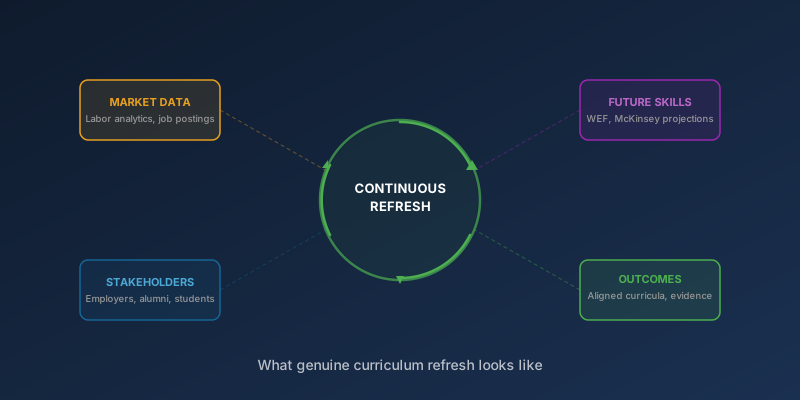
Genuine curriculum refresh synthesizes market data, stakeholder feedback, and future skills projections into a continuous cycle.
A genuine refresh synthesizes these inputs and maps them against a program's existing learning outcomes, course content, assessment methods, and credential structure. Where gaps emerge — a missing module on AI-assisted laboratory workflows, for example, or an overemphasis on a regulatory framework that has been superseded — the institution revises syllabi, adds or retires courses, updates learning outcomes, and communicates the changes to accreditors, students, and employer partners.
That is what refresh looks like when it works. The problem is that at most institutions, this process happens too rarely and too slowly to matter.
The Competitive Advantages Are Measurable
Institutions that embrace continuous curriculum alignment gain advantages across several dimensions — and these advantages are increasingly what prospective students and their families evaluate when making enrollment decisions.
In enrollment, students and families are increasingly making ROI-driven decisions. Programs that can demonstrate direct alignment between course content and in-demand job competencies attract students who might otherwise pursue bootcamps, stackable credentials, or direct-entry employment.
In employer relationships, companies that see their input reflected in course design are more willing to host interns, fund scholarships, participate in advisory boards, and hire graduates. Skills-based hiring, which 97 percent of employers now embrace, means the currency of a credential is increasingly its demonstrated competency mapping, not its institutional prestige alone.
In accreditation, regional accreditors such as the Higher Learning Commission now explicitly require institutions to improve curriculum based on periodic program review and to demonstrate that student success outcomes reflect continuous improvement. Institutions with robust, data-informed refresh processes find reaffirmation visits less burdensome because the evidence of responsiveness is already embedded in their operations.
Why This Matters Now
There is a temptation to treat the skills gap as someone else's problem — something that workforce programs or community colleges should worry about, but that doesn't apply to research universities or liberal arts institutions. That framing is increasingly untenable.
Sub-baccalaureate certificates have grown 89 percent since 2000. Microcredential adoption by institutions rose from 63 percent in 2022 to 84 percent by 2024. The four-year degree is not disappearing, but it is facing competition from shorter, more agile pathways. Universities that refresh their curricula regularly can integrate the best elements of both worlds — offering stackable credentials within degree programs, embedding industry certifications into major coursework, and ensuring that their graduates possess both the theoretical foundation and the practical competencies that employers seek.
Institutions that do not refresh risk something worse than irrelevance. They risk producing graduates who have invested time and tuition in skills that no longer command employer interest — a failure of the basic promise that higher education makes to every student who enrolls.
What's Next in This Series
This post establishes the "why." The skills-to-curriculum gap is real, it is measurable, and it is growing. But the imperative to refresh plays out differently depending on the type of institution. In the next post, we'll look at community colleges — institutions whose structural DNA makes them natural candidates for rapid curriculum adaptation, if they have the infrastructure to move at the speed the moment demands.
Part of the series: "The Curriculum Refresh Imperative." Read the previous post: Higher Education at a Crossroads.