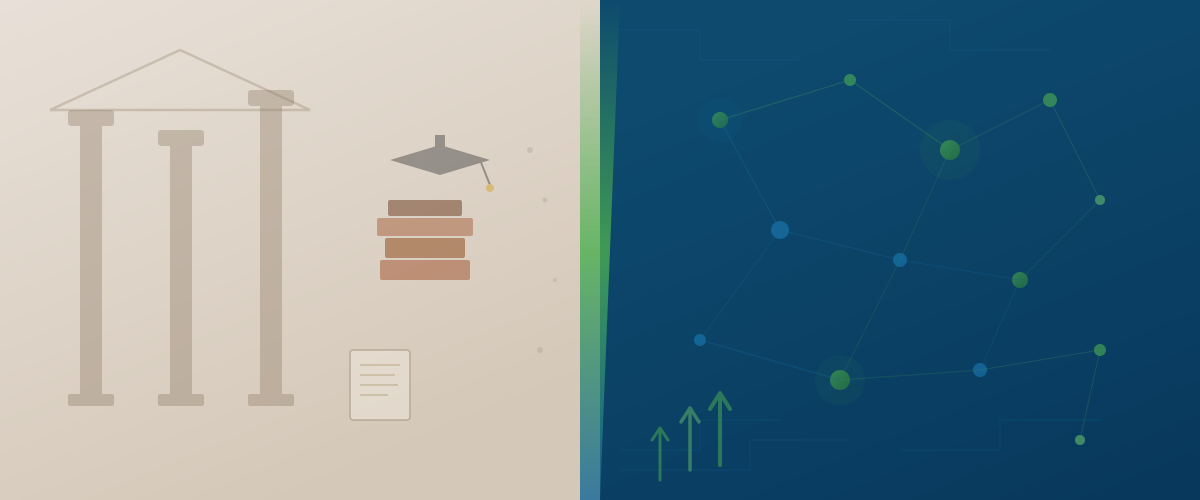
The landscape of higher education is shifting — from traditional models to an AI-integrated future.
A Seismic Shift Is Underway
The world that higher education was built to serve is changing faster than most institutions can respond. Artificial intelligence is no longer a niche topic confined to computer science departments — it is reshaping entire industries, redefining job categories, and fundamentally altering what it means to be prepared for the workforce. For colleges and universities, this is not a distant challenge on the horizon. It is happening now, and the institutions that fail to adapt risk becoming irrelevant to the very students they exist to serve.
The numbers tell a striking story. According to Stanford's 2025 AI Index, 78% of organizations are already using AI in at least one business function, up from 55% just one year prior. Generative AI adoption in the workplace surged from 22% in 2023 to 75% in 2024. An IBM global study found that 40% of the workforce will need to reskill within three years, with entry-level positions facing the most disruption. Meanwhile, a Harvard University study tracking 62 million workers found that junior positions are already shrinking at companies integrating AI — eroding the very entry points that college graduates depend on to launch their careers.
AI as Foundation — and as Challenge
For today's students, a working understanding of AI is rapidly becoming as foundational as basic computer literacy was a generation ago. AI fluency is no longer a competitive edge — it is a baseline expectation. According to NACE's Job Outlook 2025 survey, nearly two-thirds of employers now use skills-based hiring practices, and AI competencies are among the most in-demand technical skills across industries, not just in technology.
But AI is not merely an additive skill to layer onto existing curricula. It poses a direct challenge to some traditional career paths. Tasks that once required years of specialized education — drafting legal documents, analyzing financial data, writing marketing copy, even writing code — are now being augmented or automated by AI systems. The World Economic Forum's 2025 Future of Jobs report found that 41% of large employers expect to reduce their workforces within five years due to AI, even as 77% plan to retrain employees to work alongside these tools.
This dual nature of AI — as both an essential skill and a disruptive force — creates a genuine dilemma for students choosing their paths and for the institutions guiding them.

Today's students stand at a crossroads — navigating between traditional academic paths and an AI-transformed job market.
What Students Are Telling Us
Students are not passive observers in this transformation. They are paying attention, and many are worried. A 2025 Handshake survey found that over half of graduating seniors are pessimistic about starting their careers in the current economy, with computer science majors — the very students closest to the technology — expressing the most anxiety.
At the same time, students are demanding more from their institutions. The majority of the Class of 2027 (64%) say AI has already impacted their academic plans, and 61% report that it has affected their career plans. A survey of recent graduates found that 66% believe they need more training on working with new technologies in their current roles — training they expected to receive in college but often did not.
The message from students is clear: they want curricula that reflect the world they are graduating into, not the world their professors graduated from. They want to be workforce-ready on day one, with skills that employers are actually looking for. And increasingly, they are evaluating institutions based on whether the curriculum keeps pace with the realities of the job market.
The Calculator Moment
There is a useful analogy here. When electronic calculators became widely available in the 1970s, there was heated debate about whether students should be allowed to use them in the classroom. Some educators worried that calculators would undermine students' ability to do arithmetic. Others recognized that the tool was here to stay, and that the real question was how to teach mathematics in a world where computation was trivially cheap.
We are at a similar inflection point with AI. The question is no longer whether students will use AI — global student AI usage jumped from 66% in 2024 to an estimated 92% in 2025, and 88% of students now use generative AI for academic assessments. The question is whether institutions will teach students to use these tools thoughtfully, critically, and effectively, or whether they will pretend the change is not happening.
A world where AI usage is as mundane as a calculator is upon us. Higher education can either lead students through that transition or be left behind by it.
The Curriculum Refresh Problem
For higher education to continue offering meaningful, workforce-ready training, institutions and credential-granting programs need to rethink their typical academic refresh cycles. This is where the structural challenge becomes most acute.
Curriculum revision in higher education is, by design, a slow process. New courses must be proposed, reviewed by committees, approved through governance structures, and aligned with accreditation standards. A single course change can take one to two years from proposal to classroom. A full program overhaul can take three to five years or more — a timeline that was already stretched thin before AI accelerated the pace of change.
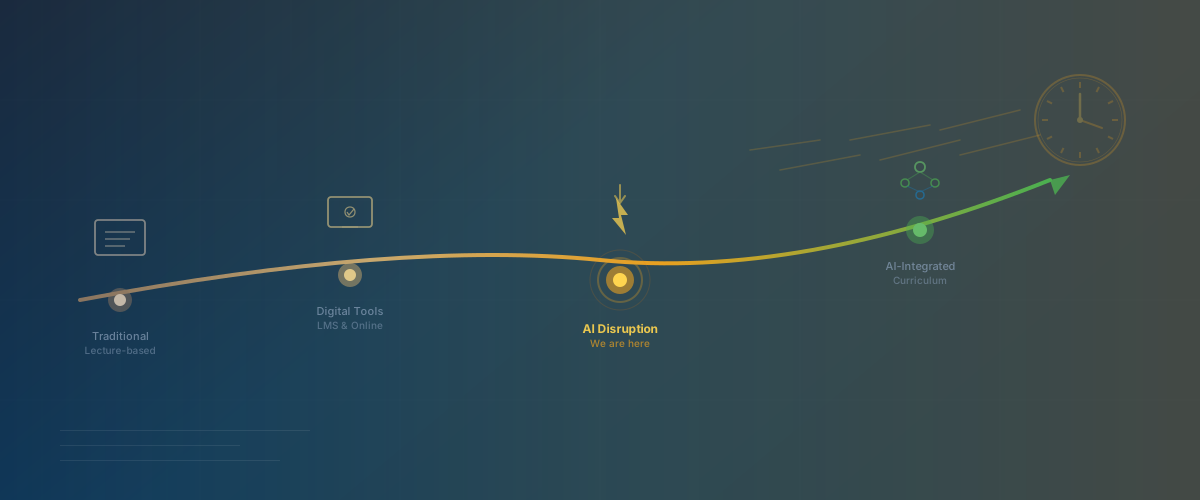
The pace of change is accelerating — and the window for curriculum adaptation is narrowing.
The result is a growing mismatch. By the time a curriculum revision is fully implemented, the industry landscape it was designed to address may have already shifted. Job postings requiring generative AI skills in non-tech roles grew ninefold between 2022 and 2024, according to Lightcast. The AI education market itself is projected to grow from $7.6 billion in 2025 to $112 billion by 2034. The world is not waiting for committee approvals.
The Resistance Problem
Compounding the structural challenge is a cultural one. Academia has a well-documented resistance to change. Tenure systems, faculty governance, disciplinary silos, and institutional inertia all work against rapid adaptation. As Brian Rosenberg, former president of Macalester College, observed in a Harvard EdCast discussion, the tenure system — while valuable for academic freedom — provides very little incentive for faculty to change what they are doing, because change is hard and job security is already guaranteed.
Students, too, are paradoxically conservative about institutional change — they push for social and political causes but rarely advocate for changes to the curriculum or the structure of their education. Alumni tend to view the institution's ideal moment as whenever they were students. And administrators, caught between competing pressures, often default to incremental adjustments rather than the kind of fundamental rethinking that the moment requires.
But sitting on it in this era is not a neutral choice. It poses a real threat to the entire idea of higher education as the primary pathway to career readiness. If a four-year degree cannot keep pace with the skills employers are hiring for, students and employers alike will look elsewhere — to bootcamps, industry certifications, employer-led training programs, and AI-powered learning platforms that can iterate in weeks, not years.
A Path Forward
None of this is meant to suggest that higher education is doomed. Quite the opposite. Colleges and universities have something that no bootcamp or corporate training program can replicate: the ability to cultivate deep, transferable thinking — critical reasoning, ethical judgment, interdisciplinary perspective, and the capacity to learn how to learn. These are precisely the skills that will matter most in an AI-saturated world, where the tools change constantly but the ability to use them wisely does not.
But harnessing that advantage requires institutions to move with more urgency than they are accustomed to. It requires treating curriculum as a living system that responds to signals from the job market, from students, and from the technology landscape — not as a static document that gets revisited on a five-year cycle. It requires giving faculty the support, incentives, and data they need to evolve their teaching. And it requires leadership that is willing to prioritize relevance alongside tradition.
The stakes are high, and the window is narrowing. But for institutions willing to act, the opportunity is equally large: to become the place where the next generation learns not just to survive the AI revolution, but to lead it.
This is the first in a series of posts exploring the intersection of AI, curriculum strategy, and the future of higher education. Future posts will take deeper dives into specific topics including skills alignment, accreditation challenges, and evidence-based approaches to curriculum redesign.