This is Part 3 of our series, "The Curriculum Refresh Imperative." In Part 2, we examined how community colleges' structural agility positions them to close the skills gap first. Now we turn to the other half of American higher education: the large public universities whose curriculum review cycles were designed for a fundamentally different era.
In Part 1 of this series, we established that the skills-to-curriculum gap is real, measurable, and growing. In Part 2, we showed that community colleges have the structural DNA to respond quickly. But what about the institutions that enroll the majority of four-year students, anchor regional economies, and produce the bulk of the nation's bachelor's and graduate degrees?
Large public universities occupy an enviable position in American higher education. They have deep faculty expertise, extensive research portfolios, established employer networks, and brand recognition that spans generations. But they also carry a structural liability that grows more costly with every passing semester: the five-to-ten-year curriculum review cycle.
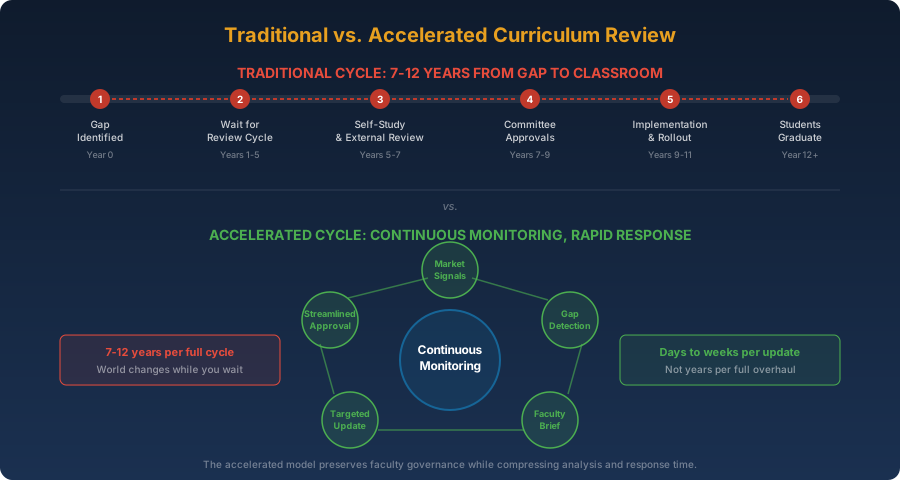
The traditional curriculum review cycle was designed for an era when skills changed slowly. That era is over.
How the Traditional Cycle Works
At most large universities, curriculum review follows a well-established pattern. A program undergoes comprehensive review every five to ten years. The process typically begins with a self-study that takes six to twelve months, followed by an external review, a series of committee deliberations, a period for revisions, and finally implementation. From the moment someone identifies a gap to the moment a revised course reaches students, the elapsed time is often seven to twelve years.
This timeline made a certain kind of sense in decades past. When the half-life of professional knowledge was measured in decades rather than years, a periodic deep review could plausibly keep programs current. But the world has accelerated. The World Economic Forum projects that 39 percent of workers' core skills will change by 2030. In fields like artificial intelligence, cybersecurity, and biotechnology, the knowledge half-life has compressed to months, not years.
A program reviewed in 2020 and not scheduled for its next review until 2027 has already missed the entire generative AI revolution, the rise of skills-based hiring, and the restructuring of entry-level roles across dozens of industries. Students graduating from that program in 2027 will have been trained on a snapshot of the world as it existed before ChatGPT.
The Financial Reality
The cost of slow adaptation is no longer theoretical. It is showing up in enrollment figures, revenue projections, and institutional credit ratings. According to recent analyses, 27 percent of undergraduate institutions in the United States are now operating at a financial loss. The causes are multiple, but one thread runs through nearly all of them: a growing perception, backed by data, that the return on investment of a traditional four-year degree is no longer guaranteed.
Students and families are making increasingly ROI-driven enrollment decisions. When a prospective student can see that a community college certificate in AI or cybersecurity leads to a $65,000 starting salary in twelve months, the value proposition of a four-year degree that has not been updated since the Obama administration becomes harder to defend. The competition is not just from other universities. It is from bootcamps, employer-sponsored training programs, stackable microcredentials, and an expanding universe of sub-baccalaureate pathways.
Sub-baccalaureate certificates have grown 89 percent since 2000. Microcredential adoption by institutions rose from 63 percent in 2022 to 84 percent by 2024. These are not fringe alternatives. They represent a structural shift in how Americans acquire and signal workforce readiness.
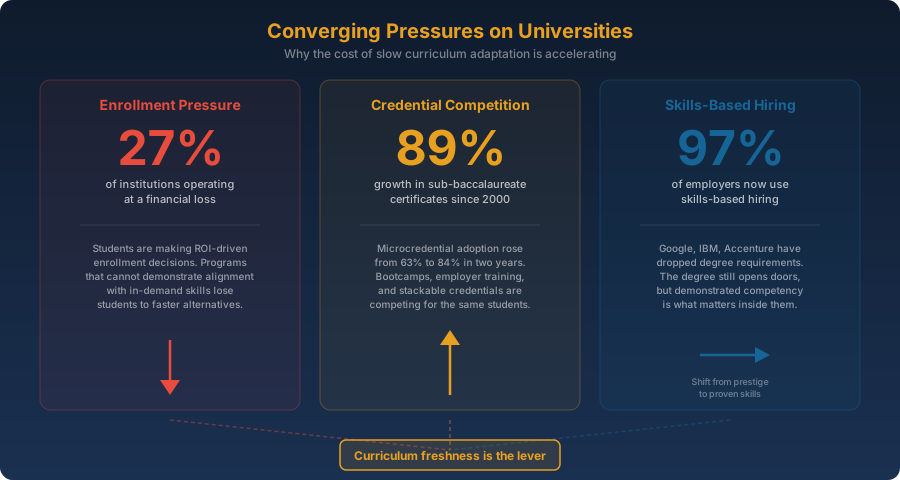
Universities face converging pressures: declining enrollment, rising competition from alternative credentials, and performance-based funding models.
The Accreditation Paradox
Regional accreditors have, to their credit, increasingly recognized the need for continuous improvement. The Higher Learning Commission, for example, now explicitly requires institutions to demonstrate that student success outcomes reflect ongoing curricular adjustment, not just periodic review. AACSB, which accredits business schools, has moved toward a continuous improvement model that expects programs to show evidence of responsiveness to market changes.
But accreditation expectations and institutional capacity often diverge. A 2024 survey by AACSB International and Hanover Research found that only one in seven provosts had reviewed their curriculum for AI readiness. The accreditors are asking for continuous improvement. The institutions are still operating on periodic review timelines. The gap between what is expected and what is practiced is itself a risk factor.
For universities, the accreditation paradox is this: the very process meant to ensure quality is, in its traditional form, too slow to prevent the kind of curricular staleness that undermines quality. An institution that waits for its next scheduled review to integrate AI literacy, data science competencies, or updated regulatory frameworks is not being thorough. It is being negligent.
Why Universities Struggle to Move Faster
If the problem is so clear, why don't universities simply accelerate their review cycles? The answer lies in the institutional structures that make large universities powerful but also slow.
Faculty governance is essential to academic integrity, but the committee structures through which curriculum changes must pass, from department curriculum committees to college-level review boards to university senates, were designed for deliberation, not speed. A single course modification can require approval from three or four separate bodies, each meeting on its own schedule.
Institutional research capacity is stretched thin. The typical large university has a small IR office tasked with serving the data needs of the entire institution. Asking that office to conduct continuous labor market analysis for every program is simply not realistic with current staffing levels.
Disciplinary silos mean that cross-cutting competencies like AI literacy, data fluency, and ethical reasoning in technology, skills that employers increasingly expect from graduates regardless of major, have no natural home in the organizational chart. No single department owns them, so no single department takes responsibility for ensuring they are current.
And risk aversion plays a role. Universities with established reputations have more to lose from a curriculum change that goes wrong than from maintaining the status quo. The institutional incentive structure often rewards caution over speed, even when caution means falling behind.
The Employers Are Not Waiting
While universities deliberate, the employer landscape is shifting beneath them. Seventy-one percent of employers still require a degree for many positions, but the basis of hiring decisions is changing rapidly. Ninety-seven percent of employers now embrace skills-based hiring practices, meaning the currency of a credential is increasingly its demonstrated competency mapping, not its institutional prestige alone.
Companies like Google, IBM, and Accenture have dropped degree requirements for significant portions of their workforce. Others are building their own training academies and credential programs. When employers decide that internal training is more efficient than waiting for universities to update their curricula, the traditional pipeline from campus to career begins to erode.
This does not mean the four-year degree is dying. It means that the degree must demonstrably deliver what it promises. And for that to happen, the programs that award the degree must be continuously aligned with the competencies the world actually needs.
What an Accelerated Cycle Looks Like
The alternative to the five-to-ten-year trap is not chaos. It is a disciplined, technology-enabled process that preserves faculty governance and academic rigor while dramatically compressing the analytical and response phases of curriculum review.
In an accelerated model, labor market signals are monitored continuously, not consulted once per review cycle. Competency gaps are flagged automatically when job posting data, employer surveys, or industry projections diverge from current learning outcomes. Faculty receive structured, data-rich briefs that allow them to focus their expertise on pedagogical decisions rather than data gathering. And the approval process is streamlined for targeted updates, distinguishing between a full program overhaul (which rightly requires deep deliberation) and a course-level content update (which should not take eighteen months).
This is not a theoretical model. As we showed in Part 2, community colleges like Alvin Community College are already operating on rapid-cycle timelines, going from employer-identified gap to graduating cohort in months. The question for universities is not whether this kind of responsiveness is possible, but whether they can adapt their institutional processes to achieve something comparable at scale.
What's Next in This Series
We have now mapped the problem across both halves of American higher education: community colleges that have the agility but often lack the infrastructure, and universities that have the resources but are trapped in slow cycles. In the next post, we examine the technology that makes continuous curriculum refresh practically achievable, compressing what used to take months into days without replacing faculty judgment or academic rigor.
Part of the series: "The Curriculum Refresh Imperative." Previous: Community Colleges — The Agility Advantage.