This is Part 2 of our series, "The Curriculum Refresh Imperative." In Part 1, we examined the widening gap between employer needs and graduate preparedness. Now we turn to the institutions best positioned to close it first.
Community colleges occupy a distinctive position in American postsecondary education. Enrolling roughly 6.5 million credit students and millions more in non-credit workforce programs, they serve as the primary gateway to economic mobility for first-generation college students, working adults, career changers, and communities underserved by four-year universities. And their institutional DNA — shorter program cycles, close employer relationships, regional workforce mandates — makes them natural candidates for rapid curriculum adaptation.
The question is whether they have the infrastructure to move at the speed the moment demands.
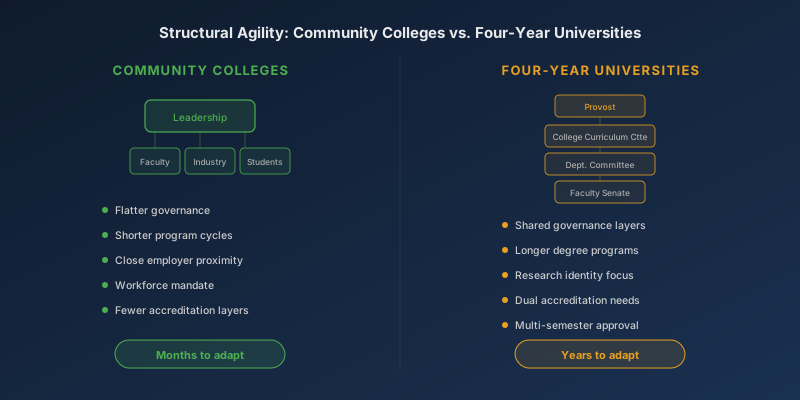
Community colleges have structural advantages that enable faster curriculum adaptation.
Why Community Colleges Can Move Fastest
Several structural features amplify the value of curriculum refresh for community colleges. Their governance structures are typically flatter and less encumbered by the faculty senate hierarchies of large universities, enabling faster decision-making. Their accreditation relationships, while rigorous, often permit greater curricular flexibility for workforce programs. And their proximity to employers — both geographically and relationally — provides a natural feedback mechanism that four-year institutions often lack.
When a community college refreshes its curriculum based on current labor data, the value proposition is immediate and tangible. A student enrolling in a two-year associate degree or a one-year certificate can be confident that the competencies they are learning map directly to the jobs available in their region when they graduate. This is not an abstract promise; it is measurable through placement rates, starting salaries, and employer satisfaction surveys.
Community colleges that fail to refresh, by contrast, risk producing graduates who have invested time and tuition in skills that no longer command employer interest. For students who chose a community college specifically because of its direct pipeline to employment, this failure is not merely disappointing — it is a breach of the institution's core promise.
The Biotechnology and AI Imperative
Not all community college programs face the same degree of curriculum pressure. Programs in rapidly evolving fields such as biotechnology, artificial intelligence, cybersecurity, and advanced manufacturing operate in a fundamentally different environment from, say, general education transfer programs. The knowledge half-life in these fields — the period after which half of a practitioner's technical knowledge becomes obsolete — has compressed dramatically.
In AI, new frameworks, model architectures, and deployment paradigms emerge on a quarterly basis. In biotechnology, the shift from small-molecule to cell-and-gene therapy manufacturing has restructured entire job families in under a decade. The U.S. bioscience industry now employs roughly 2.3 million workers, and a recent analysis by the Coalition of State Biosciences Institutes found that just over half of entry-level life sciences positions require skills that could be filled by people without a four-year degree.
This creates an enormous opportunity for community colleges — but only if their programs reflect the actual competencies that employers need today, not those that were current when the curriculum was last reviewed.
Case Study: Alvin Community College and Lonza
Alvin Community College in Texas provides an instructive example. When Lonza, a Swiss multinational, established a cell and gene therapy manufacturing facility in the Houston region, the company discovered that even candidates with bachelor's degrees lacked hands-on skills essential for onboarding — gowning procedures for clean rooms, biosafety cabinet operation, and cell transfer techniques.
Working directly with Lonza, ACC developed a new biotechnology certificate consisting of two six-week courses. The program went from concept to first graduating cohort in months, not years, producing 12 graduates who were immediately employable as Biotech Material Handlers or Core Technicians.
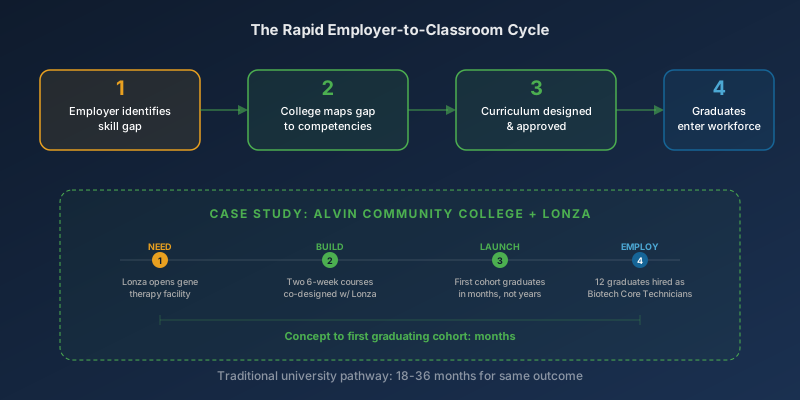
Alvin Community College's rapid-cycle partnership with Lonza — from employer need to employed graduates in months.
This kind of rapid cycle — employer identifies skills gap, college maps gap to competencies, college designs coursework, students enroll and graduate into jobs — is the model that two-year workforce programs should aspire to. But it requires an institutional infrastructure for curriculum mapping that can operate at speed. Traditional curriculum development processes, which route proposals through multiple committees over multiple semesters, are simply incompatible with the velocity of change in fields like biotech and AI.
What's Already Happening at Scale
Several states have recognized this imperative and are acting on it. California's community college system, the nation's largest with 116 campuses, has formalized rapid curriculum alignment through its Vision 2030 initiative, establishing MOUs with Nvidia, Google, OpenAI, Microsoft, IBM, and Intel to ensure curriculum in AI and emerging technology fields reflects actual industry practice.
Houston Community College graduated its first cohort of bachelor's-level AI students in 2025. Miami Dade College has partnered with industry through its Innovation and Technology programs. Intel alone has partnered with over 100 community colleges across 39 states, providing 700 hours of AI content and faculty training.
But partnerships and content are only part of the equation. The underlying program structure — the learning outcomes, course sequences, assessment rubrics, and credential stacking pathways — must be continuously remapped to reflect what the industry actually requires. A curriculum designed around TensorFlow 1.x and rule-based chatbots is not preparing students for an industry built on large language models, agentic AI, and retrieval-augmented generation.
The Concrete Benefits of Rapid-Cycle Refresh
For workforce-focused two-year programs, a rapid curriculum mapping and realignment cycle delivers several concrete benefits. Employer trust is strengthened, because companies see their input reflected in program content within semesters rather than years. Student outcomes improve, because graduates possess the specific competencies that employers are hiring for at the time of graduation, not those that were in demand three to five years earlier.
Enrollment grows, because prospective students — many of whom are adult learners making career transitions — can see a direct line between the program and the job. And institutional sustainability is enhanced, because programs with strong placement rates attract both students and the performance-based funding that an increasing number of states now allocate.
The speed at which an institution can detect, analyze, and respond to these shifts is becoming its primary competitive differentiator. Community colleges have the structural DNA to move fast. The question is whether they have the tools to match.
What's Next in This Series
Community colleges have natural agility. But what about the other half of American higher education? In the next post, we turn to large public universities — institutions whose five-to-ten-year curriculum review cycles were designed for a slower era, and where the financial and reputational stakes of slow adaptation are growing by the semester.
Part of the series: "The Curriculum Refresh Imperative." Previous: The Widening Skills-to-Curriculum Gap.