This is Part 4 of our series, The Curriculum Refresh Imperative. Part 1 examined the widening skills-to-curriculum gap, Part 2 looked at the agility advantage of community colleges, and Part 3 diagnosed the five-to-ten-year trap that keeps university curricula years behind the fields they serve. This installment turns from diagnosis to practice: what a program review actually looks like when it runs on evidence.
Every institution conducts program review. Very few would claim to enjoy it, and fewer still would claim it changes much. The typical self-study is a months-long exercise in document retrieval—syllabi gathered from department shared drives, outcome grids reconstructed from memory, curriculum maps redrawn because the last ones no longer match the catalog. The binder gets produced, the external reviewer visits, the report is filed, and the curriculum resumes its previous trajectory. The problem is not that faculty lack judgment or that reviewers lack rigor. The problem is that the raw material of review—the curriculum itself—exists as prose scattered across hundreds of documents, and prose cannot be queried.
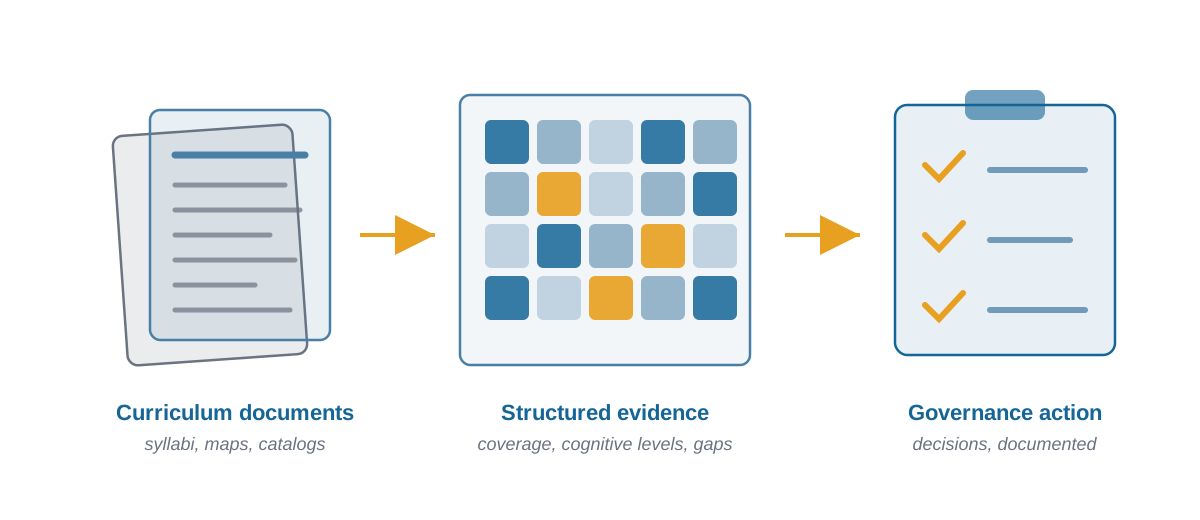
A data-driven review treats curriculum documents as structured evidence, so that governance decisions rest on what the curriculum actually says.
When Documents Become Data
The pivotal shift in modern program review is deceptively technical: treating syllabi, catalogs, and curriculum maps not as documents to be read but as data to be structured. A syllabus, after all, is a dense record of design decisions—learning outcomes and the verbs they use, assessments and their weights, topics and their sequence, prerequisites and their assumptions. Once those elements are extracted into a consistent structure across an entire program, questions that once took a semester of committee work become queries that take minutes. Which courses claim to develop each program-level outcome? At what cognitive level? Where is each outcome actually assessed? The review stops being archaeology and becomes analysis.
This shift changes the temperament of review as much as its speed. A committee arguing from impressions produces opinions; a committee looking at the same coverage map produces decisions. Structured evidence gives faculty governance something it has rarely had: a shared, neutral picture of the curriculum as it exists, against which proposals can be weighed.
Four Questions a Modern Review Answers
The first is outcome coverage. Mapping every course-level outcome to program-level outcomes exposes the two failure modes that periodic reviews most often miss: orphaned outcomes that no course meaningfully develops, and redundant clusters where five courses introduce the same competency and none carries it to mastery. A coverage heatmap makes both visible at a glance, along with the subtler pattern of outcomes that are introduced early and never reinforced—precisely the structure that learning research on spaced practice warns against.
The second is cognitive-level distribution. Outcome statements carry verbs, and verbs can be classified against frameworks such as Bloom's taxonomy or Biggs's SOLO levels. A program whose stated ambition is analysis, evaluation, and design, but whose assessed outcomes cluster at remembering and understanding, has a misalignment that no accreditation narrative can paper over. Seeing the distribution—course by course, year by year—shows whether cognitive demand actually ramps as students progress or plateaus after the first year.
The third is prerequisite integrity. Prerequisite chains form a graph, and graphs can be checked: circular dependencies, sequences that quietly assume material no prior course teaches, bottleneck courses whose failure rates ripple through time-to-degree. These structural defects are nearly invisible when the curriculum lives in catalog prose, and nearly trivial to detect once it is structured.
The fourth is alignment with the labor market the program feeds. This is where external data earns its place in review. Lightcast's analysis of hundreds of millions of job postings found that 37 percent of the top twenty skills requested for the average U.S. job changed between 2016 and 2021, and about one in five of those skills was entirely new. A program reviewed on a five-to-ten-year cycle is, by that arithmetic, structurally incapable of tracking its own target.
The consequences of ignoring that drift are well documented. Talent Disrupted, the 2024 study from the Burning Glass Institute and the Strada Institute for the Future of Work, found that 52 percent of bachelor's graduates are underemployed a year after graduation, and 45 percent remain so a decade later. Curriculum is not the only cause, but a review process that never compares program outcomes against the skills employers actually request cannot even see its share of the problem.
What Accreditors Actually Expect
It is worth being precise about the external bar, because it is higher than the binder-production ritual suggests. The Higher Learning Commission's Criterion 4.A requires that an institution "maintains a practice of regular program reviews and acts upon the findings"—the acting, not the reviewing, is the requirement. SACSCOC's Standard 8.2.a likewise expects institutions to identify expected student learning outcomes for each program, assess the extent to which students achieve them, and provide evidence of seeking improvement based on analysis of the results. Both formulations describe a loop: evidence, analysis, action, documentation.
The sector's own assessment leaders have long observed that the loop rarely closes. The National Institute for Learning Outcomes Assessment's 2018 national survey of provosts, drawing responses from 811 institutions, found that while assessment activity had expanded and diversified, institutions still gathered more evidence than they used, and provosts' most consistent aspiration was greater faculty engagement with results—a finding echoing NILOA's earlier surveys, in which roughly six in ten provosts named wider faculty use of assessment results as their top priority. The bottleneck, in other words, is not collection. It is the passage from insight to action.
Governance That Acts on Evidence
Closing that loop is chiefly a governance design problem, and structured curriculum data changes what governance can be. When the coverage map, cognitive-level distribution, and prerequisite graph exist as living artifacts rather than self-study appendices, review stops being an event and becomes a standing capability. Curriculum committees can meet against a current picture of the program rather than commissioning one. Proposals to add, modify, or retire a course can arrive with their evidence attached: here is the outcome this course reinforces, here is the gap it fills, here is what the map looks like after the change. Smaller decisions can be made more often, which is precisely the operating rhythm that Part 3 of this series argued the five-to-ten-year cycle forecloses.
Just as important, action becomes documentable. The accreditor's question—show us that you acted on findings—is answerable by construction when every curricular change is linked to the evidence that prompted it. The self-study stops being a retrospective reconstruction and becomes, in effect, an export of decisions the program was already making and recording. Faculty time shifts from assembling evidence to exercising judgment on it, which is the part of governance that actually requires faculty.
From Insight to Action
None of this requires institutions to build a curriculum data infrastructure from scratch. We built Curriculum Assist to do exactly the conversion this essay describes: it ingests the syllabi and program documents an institution already has, extracts their outcomes and assessments into structured form, analyzes cognitive levels against Bloom's and SOLO frameworks, maps course outcomes to program learning outcomes, and renders the results as gap heatmaps and accreditation-readiness reports that a curriculum committee can act on in its next meeting rather than its next decade. The judgment about what to change remains where it belongs, with faculty. What changes is that the judgment finally gets to work from evidence.
The first three parts of this series argued that curriculum refresh is urgent, that agile institutions are already demonstrating it can be done, and that traditional review cycles are structurally too slow. The practical conclusion is this: the institutions that escape the trap will be the ones that turn their curricula into data they can see—and build governance willing to act on what it sees.