Ask a faculty committee how a new program came to look the way it does, and the honest answer is usually historical rather than pedagogical. The courses existed already, or resembled courses that existed elsewhere. The textbook had fourteen chapters and the semester had fourteen weeks. A senior colleague had taught the sequence that way for twenty years. None of this is malpractice—it is how institutions transmit knowledge across generations of faculty. But it means that most curricula are built forward from content, when six decades of research on learning and instruction point firmly in the other direction: start from what graduates must be able to do, and work backward.
This matters more now than it did a decade ago. As programs face pressure to refresh faster and defend their outcomes more explicitly, the design method itself—not just the content—becomes the thing worth examining.
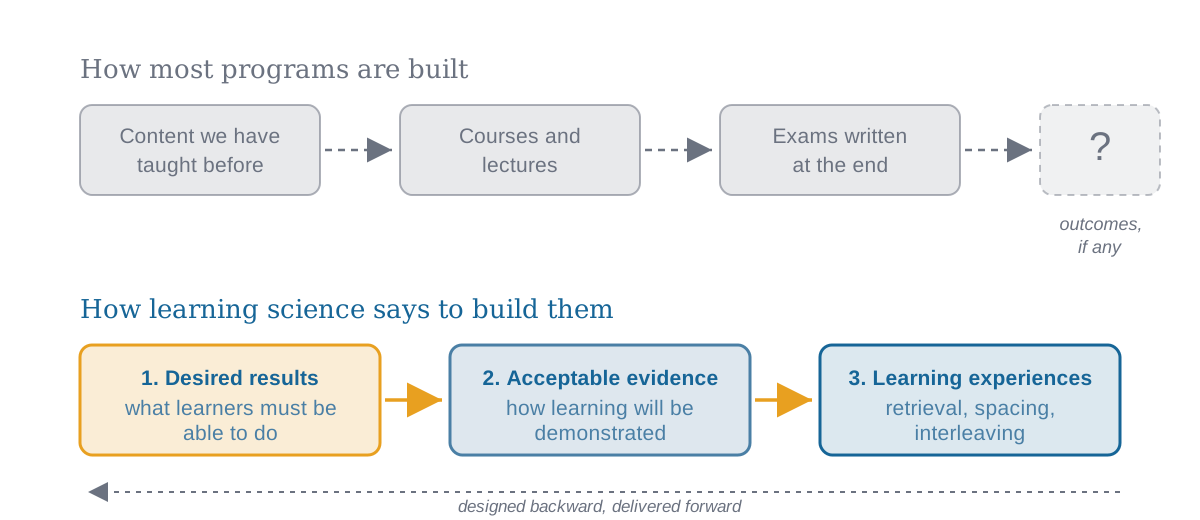
Forward design starts from available content and hopes outcomes follow. Backward design fixes the outcomes first, then derives evidence and learning experiences from them.
The Forward-Design Default
Grant Wiggins and Jay McTighe, in Understanding by Design (ASCD, expanded second edition, 2005), gave the forward-design habit a memorable diagnosis. They called its two most common forms the "twin sins" of curriculum planning: activity-oriented design, in which engaging experiences are assembled without a clear account of what enduring understanding they produce, and coverage-oriented design, in which the goal is to march through a body of material—a textbook, a canon, a topic list—on the assumption that exposure equals learning.
Both patterns are recognizable at the program level, not just in individual courses. A degree assembled by aggregating existing courses is coverage-oriented design at institutional scale. The program's stated outcomes, when they exist at all, are frequently written after the courses are chosen—reverse-engineered to describe what the curriculum already happens to do, rather than governing what it should do. When outcomes are decorative rather than architectural, no one can say with confidence where in the curriculum a given capability is developed, how it is assessed, or what would break if a course were removed.
Backward Design: Three Stages, in Order
Wiggins and McTighe's alternative is disarmingly simple. Stage one: identify desired results—what learners should know, understand, and be able to do at the end. Stage two: determine acceptable evidence—what performances, products, or assessments would convince a skeptic that those results were achieved. Stage three, and only then: plan learning experiences and instruction that prepare students to produce that evidence. The sequence is the point. Assessment is designed before instruction, so that teaching aims at demonstrated capability rather than completed coverage.
The same logic reached higher education through a different lineage. John Biggs, in a 1996 paper in Higher Education titled "Enhancing teaching through constructive alignment," argued that intended learning outcomes, teaching activities, and assessment tasks must form a single aligned system. The "constructive" half of the term reflects the constructivist premise that students build understanding through what they do; the "alignment" half is the practical discipline of making sure the verbs in the outcome statements—analyze, design, evaluate—are the same verbs students actually perform in class and are actually judged on in assessment. Biggs's SOLO taxonomy gave designers a way to calibrate those verbs to levels of cognitive complexity, from reproducing isolated facts to extending principles into new domains.
Biggs's sharpest insight was about student behavior: learners orient to the assessment, not the syllabus. If a program's stated outcomes ask for evaluation and synthesis but its exams reward recall, the exams win. Misalignment is not a cosmetic flaw; it silently rewrites the curriculum from the inside.
What the Cognitive Evidence Adds
Backward design and constructive alignment tell us how to structure a program around outcomes. A parallel body of cognitive research tells us which learning experiences actually produce durable capability—and its findings are consistently counterintuitive.
The most robust finding is the testing effect. Henry Roediger and Jeffrey Karpicke's 2006 experiments in Psychological Science had students either repeatedly restudy prose passages or repeatedly recall them from memory. On a test five minutes later, restudying looked better. On delayed tests, the pattern reversed decisively: students who had practiced retrieval retained substantially more than students who had reread. Learning that feels efficient in the moment can be the least durable, and vice versa.
Spacing shows the same signature. A 2006 meta-analysis by Cepeda, Pashler, Vul, Wixted, and Rohrer in Psychological Bulletin, synthesizing 839 assessments of distributed practice across 317 experiments, confirmed that practice separated in time reliably beats the same amount of practice massed together—and, crucially, that the optimal spacing interval grows as the retention interval grows. If we want graduates to retain something for a career rather than a final exam, the practice schedule that achieves this spans months and courses, not weeks within one syllabus.
Interleaving completes the trio. Doug Rohrer and Kelli Taylor showed in a 2007 study in Instructional Science that simply shuffling mathematics practice problems—so students must choose a strategy rather than apply the one just taught—markedly improves later test performance. In a 2010 follow-up in Applied Cognitive Psychology, interleaved practice depressed performance during the practice session itself yet roughly doubled scores on a test given one day later.
The definitive audit of these techniques came in 2013, when John Dunlosky and colleagues published "Improving Students' Learning With Effective Learning Techniques" in Psychological Science in the Public Interest. Reviewing ten common study and instructional techniques, they rated only two—practice testing and distributed practice—as high utility. The techniques students and instructors lean on most heavily, including rereading, highlighting, and summarization, earned low-utility ratings.
Why This Is a Program-Level Problem
It is tempting to file retrieval, spacing, and interleaving under classroom technique—something for individual instructors to adopt. But the deepest implications are structural. Spacing at the intervals that matter for long-term retention requires concepts to reappear across courses and semesters, which is a curriculum map decision, not a lesson plan decision. Interleaving across problem types presupposes that programs know which skills recur where, so that later courses can deliberately re-invoke earlier ones. Retrieval practice at the program level means cumulative assessment—capstones and milestone tasks that force reconstruction of learning from prior terms rather than testing each course as a sealed unit. No individual instructor, however evidence-informed, can impose this architecture from within one course.
This is where forward-built curricula quietly fail. A sequence of internally coherent courses can still leave core outcomes touched once and never revisited, prerequisite chains that space practice by accident or not at all, and assessment regimes that reward exactly the massed, recall-oriented studying the evidence warns against.
Make the Rationale Inspectable
If there is a single discipline worth adopting from all of this, it is that design rationale should be explicit and inspectable. A program built backward can answer, in writing, questions a forward-built program cannot: which courses develop each outcome, and at what cognitive level; where each outcome is assessed, and with what evidence; where practice is spaced and skills are interleaved across the sequence; and what the program would lose if any given course changed. When the rationale exists only in the memories of the faculty who assembled the curriculum, every review becomes archaeology and every revision becomes negotiation. When it is documented—outcome by outcome, decision by decision—it can be examined, challenged, and improved, which is precisely what accreditors increasingly ask for and what good governance requires anyway.
Explicit rationale also protects against the twin sins recurring. An activity survives review not because it is beloved but because it demonstrably produces evidence of a stated outcome. Content earns its place by contribution, not tenure.
Designing With the Principles Built In
This is the design philosophy we built into our own tools. Curriculum De Novo constructs complete new academic programs the way Wiggins and McTighe prescribe: outcomes first, evidence second, courses and validated syllabi last, with the alignment between them recorded rather than assumed. Meliore applies the same discipline to short-cycle programs beyond the degree—workforce training, extension, continuing education—where it generates several comparable program architectures and states the pedagogical rationale and tradeoffs of each explicitly, so that the reasoning behind a design is a document you can read, not a decision you have to trust.
The research settled these questions years ago. Programs that start from outcomes, align assessment to them, and schedule practice the way memory actually works produce more durable learning than programs assembled forward from content. The remaining question for institutions is not what the science says—it is whether their design process leaves any evidence that anyone consulted it.