For most of the history of formal education, the record of what a person learned has been an institutional possession rather than a personal one. Transcripts live in registrars' vaults and are released, slowly and for a fee, on request. Training certificates live in filing cabinets and frames. When an employer wants to confirm that a candidate actually completed a program, the process still frequently involves a phone call, a faxed release form, or simple trust. The learning belongs to the learner; the proof, inconveniently, does not.
Over the past two years, that arrangement has begun to change in earnest—not because of any single product, but because a family of open technical standards has matured to the point of real adoption. Together they describe a world in which a credential is a signed digital object the learner holds, carries, and presents; in which the credential describes itself in machine-readable terms; and in which anyone can verify its authenticity in seconds without contacting the issuer. For the institutions and organizations that issue credentials, this is both an opportunity and a quiet deadline.
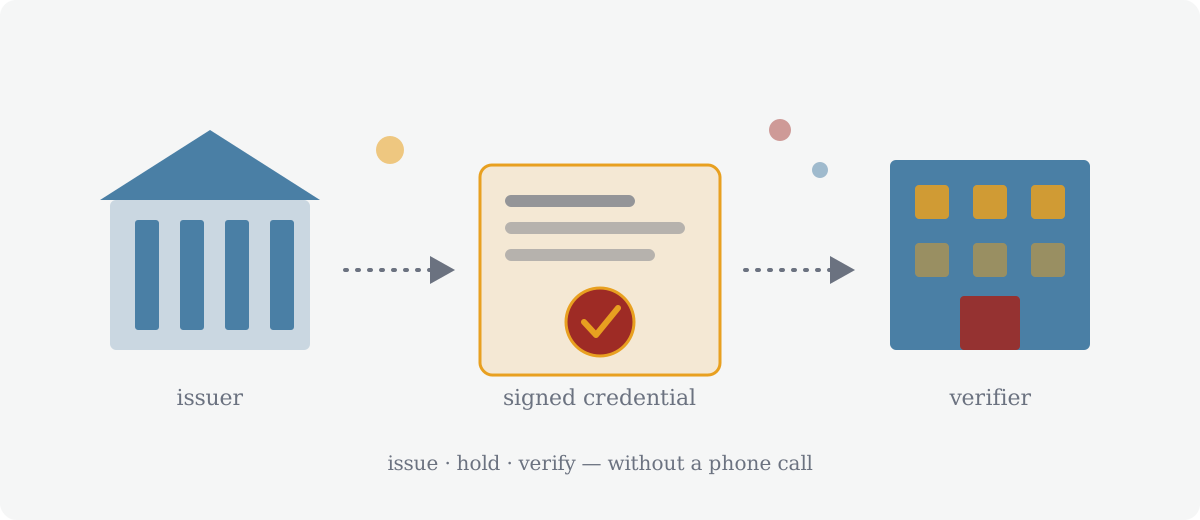
The three-party model: an issuer signs, a learner holds, a verifier checks—no phone call required.
The Standards Have Arrived
The foundational layer is the W3C's Verifiable Credentials Data Model, which reached a major milestone when the Verifiable Credentials 2.0 family of specifications became a W3C Recommendation in May 2025. The model is deliberately general: it defines how any set of claims—a license, a diploma, a safety certification—can be expressed as a cryptographically signed document exchanged among three parties: an issuer, a holder, and a verifier. The signature travels with the credential, so tampering is detectable and verification requires no callback to the source.
Education's implementation of that model is Open Badges 3.0, finalized by 1EdTech in 2024. Where earlier badge generations were essentially images with hosted metadata—verifiable only as long as the issuer's server stayed online—Open Badges 3.0 rebuilds the badge as a true Verifiable Credential. Each badge is digitally signed by its issuing organization, can carry rich alignment to skills and competency frameworks, and remains verifiable even if it is forwarded, stored in a wallet, or printed into a PDF. For short-cycle programs—the certificates, micro-credentials, and CEU sequences that make up most of the credentialing world—this is the format in which their outcomes will increasingly be expected to travel.
Making Credentials Legible, Not Just Verifiable
Verification answers one question: is this credential authentic? It does not answer the harder one: what does it mean? That gap is what the Credential Transparency Description Language (CTDL), maintained by Credential Engine, exists to close. CTDL is a common vocabulary for describing credentials and everything around them—the competencies they attest, the assessments behind them, the learning opportunities that lead to them—as linked open data, so that different systems can compare credentials on their substance rather than their marketing. The need is not hypothetical: Credential Engine's Counting Credentials 2025 report identified more than 1.8 million unique credentials in the United States. In a landscape that crowded, a credential that cannot describe itself in a common language is, functionally, invisible.
The third piece assembles individual credentials into a coherent whole. The Comprehensive Learner Record (CLR), whose 2.0 standard 1EdTech released in March 2025, packages achievements from multiple providers—courses, badges, work-based learning, co-curricular accomplishments—into a single verifiable, learner-controlled record. CLR 2.0 is itself built on the Verifiable Credentials model, which means the lifetime record inherits the same portability and tamper-evidence as each credential within it. The direction of travel is unmistakable: away from institution-held transcripts and toward a learner-held record that accumulates across a working life.
The Employer Side of the Handshake
Standards only matter if someone on the receiving end reads them, and here the picture is genuinely mixed. The rhetoric of skills-based hiring is everywhere: research from SHRM found that roughly 45 percent of U.S. workers already hold some form of alternative credential, and that executives, supervisors, and HR professionals overwhelmingly say such credentials bring value to the workplace. More than two dozen states have moved to strip unnecessary degree requirements from public-sector jobs, an effort Brookings has tracked as governors of both parties issue executive orders embracing skills-first hiring.
Practice, however, lags pronouncement. A joint study by the Burning Glass Institute and Harvard Business School found that although the number of postings dropping degree requirements nearly quadrupled between 2014 and 2023, actual hiring changed far less: by their estimate, fewer than one in 700 hires in a given year genuinely reflected the new policies. And the plumbing is part of the problem—SHRM's research found that among organizations using automated résumé screening, only about a third of those systems could even recognize alternative credentials when they appeared.
It is tempting to read those numbers as an indictment of skills-based hiring. The better reading is that they are an indictment of illegible credentials. An applicant tracking system cannot honor a certificate that arrives as a JPEG with no machine-readable claims. A hiring manager cannot weigh a micro-credential whose underlying competencies were never articulated. The standards described above exist precisely to close this loop—but they can only close it if issuers adopt them, and if the programs behind the credentials are designed with explicit, describable outcomes in the first place. Portability is not a feature you bolt onto a program after the fact. It is a property of programs whose design was rigorous enough to have something worth describing.
What Issuers Should Do Now
For universities, the work is largely underway; registrars and credentialing offices are piloting CLR implementations and badge programs across the sector. The organizations at greater risk of being left behind are the ones that issue the majority of America's credentials: workforce programs, continuing education units, extension services, industry trainers, and nonprofits. Few of them have standards specialists on staff, and most of their program documentation was never written with machine-readability in mind. The practical prescription is straightforward, if not easy: define program outcomes explicitly, align them to recognized competency frameworks where they exist, and issue completions in standards-native formats rather than ornamental PDFs.
This is one of the problems Meliore was built to make tractable. Because Meliore designs short-cycle programs around explicit outcomes, contact-hour and credential logic from the start, the credentialing layer comes along naturally: program architectures carry the structured descriptions needed for Open Badges 3.0 issuance, CTDL publication, and inclusion in Comprehensive Learner Records, with outputs that meet WCAG 2.2 AA accessibility requirements. An extension service or training provider should not need a semantic-web engineer to make its credentials legible to the wider ecosystem; the design tool should carry that burden. Institutions mapping existing academic programs to competency frameworks will find related ground covered by Curriculum Assist.
The portable learning record is no longer speculative infrastructure. The standards are ratified, the wallets are shipping, and the policy environment—however unevenly—is pulling in the same direction. What remains undecided is which credentials will be worth carrying. That question is settled not at the moment of issuance but at the moment of design, and it favors the programs that took design seriously.