Ask a provost what accreditation preparation looks like on the ground and the answer rarely involves the word "quality." It involves a steering committee, a shared drive with hundreds of documents, a year of evidence-gathering, and a corps of faculty pulled away from teaching and scholarship to reconstruct what the institution has been doing all along. The self-study — the centerpiece of institutional and programmatic accreditation alike — has become, at many institutions, an exercise in archaeology: digging through old syllabi, assessment reports, and committee minutes to assemble a narrative of effectiveness after the fact.
The scale of this effort is easy to underestimate because so much of it is absorbed invisibly into faculty and staff workloads. But where researchers have tried to measure it, the numbers are sobering. A widely cited multi-institutional study led by Vanderbilt University, drawing on roughly 600 interviews and 3,500 survey responses across thirteen diverse institutions, estimated that compliance with federal regulations costs the American higher education sector approximately $27 billion per year — and that accreditation-related compliance alone accounts for roughly $3 billion of that total. At the participating institutions, compliance consumed between 3 and 11 percent of non-hospital operating expenditures.
The study drew criticism and debate — a thoughtful Inside Higher Ed essay at the time argued that much of what gets booked as "accreditation cost" is really the cost of quality assurance an institution should be doing anyway. That is a fair point, and it sharpens rather than blunts the question. If assessing student learning and improving programs is work institutions should be doing continuously, why does so much of the expense concentrate in a frantic, episodic scramble every eight or ten years? The burden is not the standard; the burden is the reconstruction.
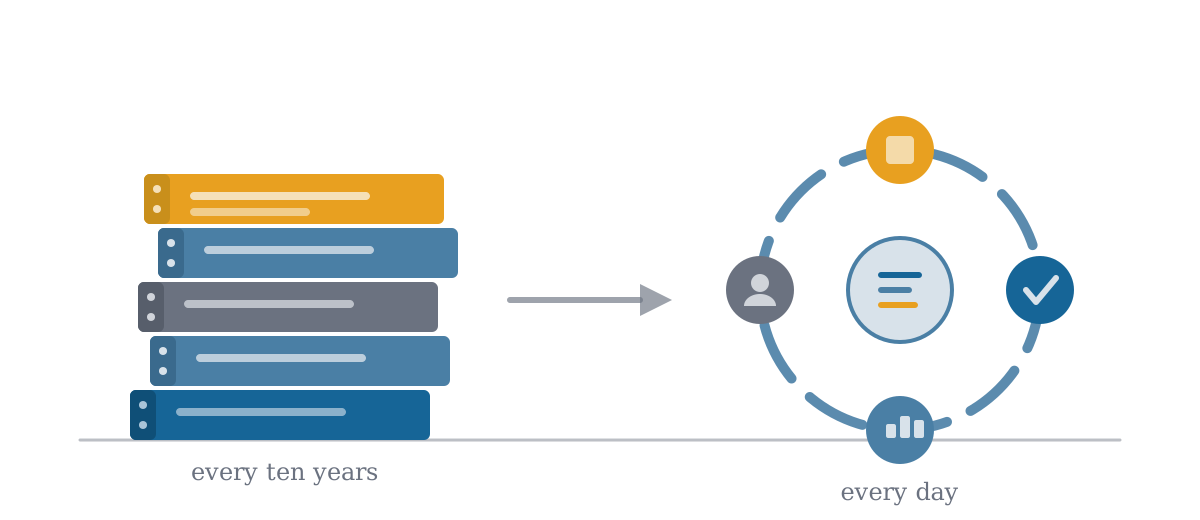
The episodic binder versus the continuous cycle: accreditors are increasingly asking for the second, while institutions are still staffed and organized to produce the first.
What Accreditors Are Actually Asking For
It is worth reading the standards themselves, because they have quietly converged on a common demand: not documentation of a moment, but evidence of a process. The Higher Learning Commission's Criterion 4 requires that institutions demonstrate responsibility for the quality of their educational programs and evaluate their effectiveness "through processes designed to promote continuous improvement" — language reaffirmed in the revised Criteria for Accreditation. HLC's Open Pathway goes further, structuring the ten-year cycle around ongoing assurance reviews and a Quality Initiative rather than a single monolithic visit.
SACSCOC's Standard 8.2.a, which its own interpretive guidance flags as a federally mandated standard that on-site committees must examine regardless of the off-site committee's judgment, asks institutions to identify expected student learning outcomes for each educational program, assess the extent to which they are achieved, and provide evidence of seeking improvement based on the results. The Middle States Commission's Standard V, carried into its Fourteenth Edition standards, centers on educational effectiveness assessment — the demonstration that assessment findings actually inform curricular decisions. In the programmatic world the expectation is even more explicit: ABET's Criterion 4 is simply titled "Continuous Improvement" and requires regularly used, appropriately documented processes for assessing student outcomes, with results "systematically utilized" as input to program improvement. AACSB's Standard 5 on assurance of learning expects schools to show that the curriculum itself changed as a result of assessment — what the standard's guidance calls closing the loop.
Read together, these standards describe an institution in which curriculum, outcomes, and evidence are connected all the time. None of them actually asks for a binder. The binder is what institutions produce because their curriculum data cannot answer the questions any other way.
The Anatomy of the Burden
Consider what a typical reaffirmation requires. Accreditors and their guides consistently advise that self-study preparation begin eighteen months to two years before the evaluation visit; the New England Commission's self-study guide and MSCHE's self-study materials both assume a multi-year runway with a steering committee, working groups for each standard, and an evidence inventory assembled from across the institution. During that window, faculty members chair working groups, department chairs excavate assessment reports, and institutional research staff reconcile outcome statements that were written by different committees in different decades using different verbs.
The deepest inefficiency is that most of this labor produces nothing durable. The evidence is assembled into a narrative, the narrative is reviewed, the visit concludes — and the connective tissue that was painstakingly built between courses, outcomes, and assessments begins decaying the day the team leaves. Curricula keep changing; the map does not. When the next review arrives, or when a program adds a new accreditor, or when a state board asks a pointed question, the archaeology begins again. Institutions are, in effect, paying repeatedly to rediscover their own curriculum.
Living Curriculum Data Changes the Calculus
The institutions that experience accreditation as something closer to a report-generation exercise than a crisis share a structural trait: their curriculum exists as data, not as a pile of documents. Course learning outcomes are linked to program learning outcomes; program outcomes are linked to institutional goals and, where relevant, to accreditor-specific criteria. Assessment evidence attaches to those links rather than living in departmental folders. When the curriculum changes — a course revised, an outcome retired, a program restructured — the map changes with it.
This is precisely the operating model the standards now reward. HLC's Open Pathway assurance reviews, SACSCOC's expectation of "ongoing" improvement-seeking, ABET's demand for "regularly" applied documented processes, and AACSB's closing-the-loop requirement all presume that evidence accumulates continuously. An institution with living curriculum data can answer the canonical accreditation questions — where is each program outcome taught, at what cognitive level, with what assessment, and what changed as a result? — on any given Tuesday, not only in year nine of a ten-year cycle. The self-study then becomes what accreditors always intended it to be: a reflective narrative layered over evidence that already exists, rather than a two-year evidence-manufacturing project.
Getting to that state has historically been its own multi-year project, which is why so few institutions attempt it between reviews. This is the problem we built Curriculum Assist to address. It ingests the documents institutions already have — syllabi, program descriptions, outcome statements — and constructs the connective tissue automatically: per-outcome traceability from course to program level, Bloom's and SOLO cognitive-level analysis, gap heatmaps that show where an outcome is claimed but never taught or assessed, and accreditation-ready reports aligned to the evidence expectations described above. The point is not to write the self-study for anyone. It is to make the underlying map cheap enough to keep alive, so that the next review draws on a living record instead of a reconstruction.
From Episodic Compliance to Standing Capacity
Accreditation is not going away, and in the current policy climate the scrutiny attached to it is more likely to intensify than relax. But the burden, as institutions experience it, is largely self-inflicted in one specific sense: it is the cost of storing curriculum knowledge in formats that cannot be queried. Faculty time is the scarcest resource on most campuses. Spending it on judgment — interpreting evidence, debating what a program should become — is the work accreditation was designed to provoke. Spending it on retrieval is waste. The institutions that thrive under continuous-improvement regimes will be those that treat their curriculum as a living dataset and their self-study as a snapshot of it, rather than treating every review cycle as an occasion to rebuild institutional memory from scratch.